InMyKorea.com: Rebuilding a Korea Travel Guide for Speed, Security and Search
How Beewebby runs InMyKorea.com: a WordPress travel guide moved to static hosting on Cloudflare Pages, with interactive trip tools, Search Console tracking and social automation.

InMyKorea.com is an independent South Korea travel guide written by Joel, a British expat who has lived in Korea since 2015, and Beewebby has looked after its SEO, speed and technology since 2024. In October 2026 we rebuilt it: WordPress now runs offline, and the public site is a static export served from Cloudflare Pages. Around that sit interactive trip-planning tools, a weekly Search Console report that scores every content change, and a pipeline that turns articles into Instagram and Facebook posts.
This post was first published in June 2024 when we onboarded InMyKorea, and was rewritten in November 2026 to cover the rebuild.
What is InMyKorea?
InMyKorea is a first-hand guide to travelling and living in South Korea: transport, money, phrases, food, hiking, seasons, festivals and expat life. It has 94 published articles and 15 pages, written from more than a decade of living there.
In the 28 days to 6 November 2026, Google Search Console recorded 168,251 impressions and 985 clicks across 137 pages, at an average position of 8.7. These guides do most of that work:
| Guide | Clicks | Impressions | Avg. position |
|---|---|---|---|
| T-money card guide | 310 | 44,334 | 7.1 |
| Basic Korean phrases for travel | 207 | 42,982 | 3.3 |
| 1 week on Jeju Island in winter | 124 | 5,267 | 8.0 |
| Driving in Korea as a tourist | 49 | 2,102 | 7.8 |
| Hiking Seoraksan National Park | 30 | 1,294 | 7.7 |
| Where does it snow in Korea? | 13 | 14,740 | 3.7 |
Source: Google Search Console, 10 October to 6 November 2026.
Why we moved InMyKorea off live WordPress
A live WordPress site runs PHP, a database, a login page and every plugin's code on the public internet, and any one of them can be the way in. For a content site that changes a few times a week, none of that has to be public.
So we split the site in two:
- WordPress runs offline, in Docker on our own machine, with no internet access. Joel's content, the GeneratePress theme, Rank Math SEO and the block layouts all stay exactly as they were.
- Simply Static exports every page to plain HTML, which is deployed to Cloudflare Pages and served from Cloudflare's global network.
The public site now has no PHP, no database and no admin login: /wp-login.php simply returns a 404.
What the rebuild had to keep working
| Feature | How it works on a static site |
|---|---|
| Site search | Pagefind builds a search index at deploy time; the search page runs in the browser |
| Redirects | Rank Math's redirects converted to a Cloudflare _redirects file |
| Short links in YouTube descriptions | 78 /links/ short links served by a small Cloudflare Pages Function that logs each click to a D1 database |
| Comments | Existing comments still show; new comments are closed |
| Ads, affiliates and newsletter | Kept, and checked against an allowlist of approved domains on every deploy |
| Security headers | HSTS, nosniff, a strict referrer policy and framing protection on every page |
Deploy checks that catch problems first
Every deploy runs the same steps, and stops if any fail:
- Prune: drop uploads no page uses, taking the build from about 31,800 files to about 10,500, safely under Cloudflare Pages' 20,000-file limit
- Optimise: fix the theme's hero images so the browser finds them sooner, which helps Largest Contentful Paint
- Scan: a malware gate checks every exported file for injected scripts, unknown third-party domains and known attack patterns
- Record: a SHA-256 manifest of every deployed file is committed to git, so any later change to the live site can be detected. There have been 63 deploys since the rebuild on 13 October 2026.
We also cut the export from 15 minutes to 6.5 by crawling only the files pages actually reference.
Interactive tools for trip planning
Static doesn't have to mean flat. Small, dependency-free JavaScript tools now sit inside articles, added at deploy time:
- Best time to visit Korea: a month-by-month explorer with average temperatures and rainfall for Seoul, Busan and Jeju (from Korea Meteorological Administration 1991 to 2020 averages), events, public holidays and the best guides for each month
- Climate Card vs T-money calculator: enter your days in Seoul and journeys per day, and it works out whether the Climate Card Tourist Pass or pay-as-you-go T-money is cheaper
- Airport route finders on the Incheon Airport to Seoul, Myeongdong and Hongdae guides
- Photo slideshows of the social carousels, embedded in articles such as the Chilgapsan Ice Fountain Festival guide
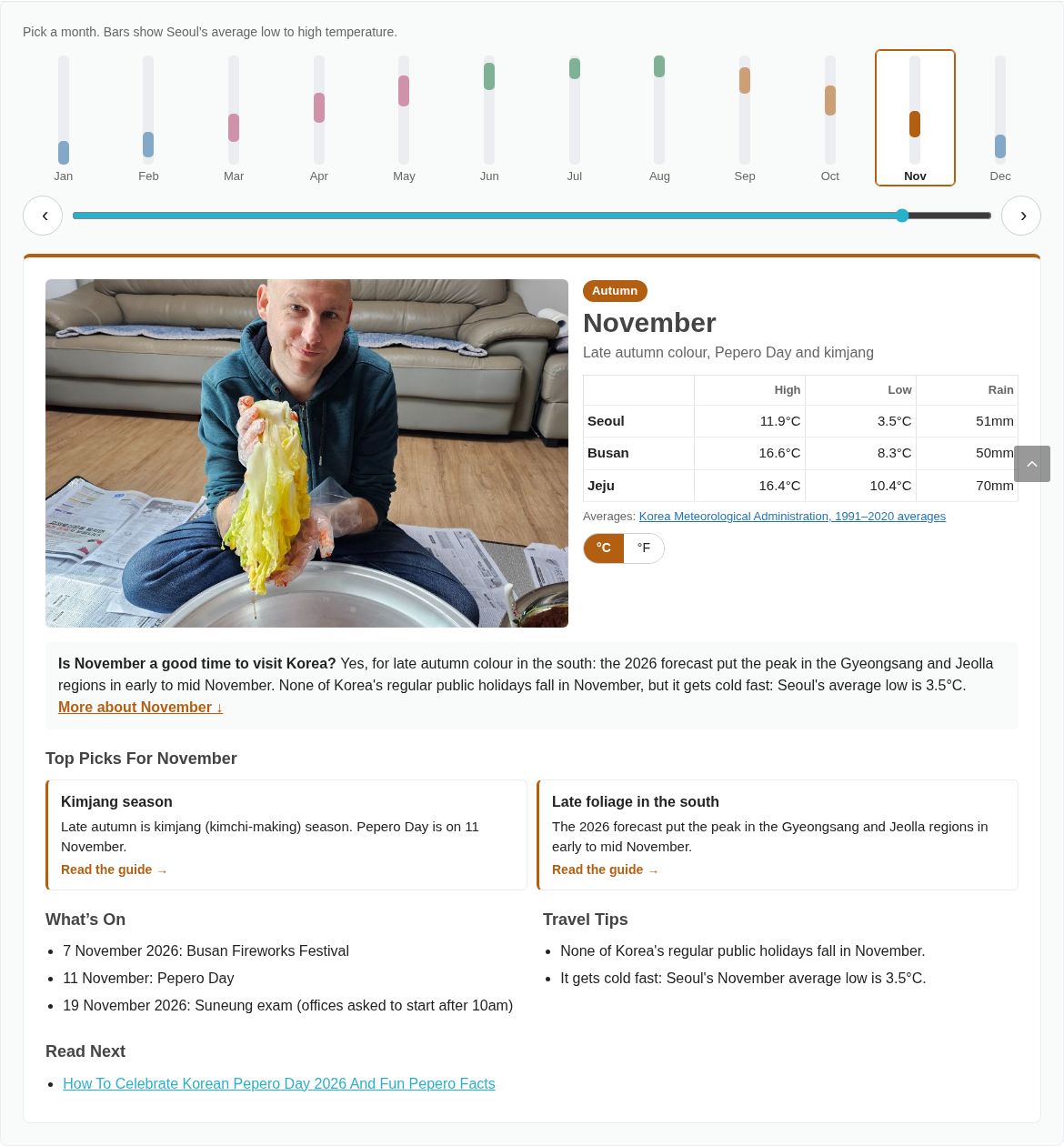
Tools like these give readers something a summary in an AI answer can't, and give other sites a reason to link to the page.

SEO and content automation
Content you can review like code
Every post and page is exported from WordPress into a Markdown file in git. Edits are made there, reviewed as a diff, then applied back to WordPress with a script, so every change can be read, approved and reverted. AI helps research and draft updates, but it only ever proposes them: a person approves every change before it goes live.
A weekly Search Console report
A weekly timer pulls Search Console data into a local history database and produces two reports:
- Quick wins: pages ranking in the top 10 with 100+ impressions but a click-through rate under 2%. The latest report found 25, including the Kakao Taxi guide and WOWPASS guide, so their titles and descriptions were rewritten first.
- Change impact: each content change is logged by type (title and description, FAQ, new section, comparison table, internal links, facts), then compared with a control group of unchanged pages for clicks, position and click-through rate. 47 changes were logged in the first month.
Recent examples include a rebuilt T-money guide with a comparison table and FAQ, a Hallasan winter hiking refresh with the current bus 240 winter timetable, and an expanded Where does it snow in Korea? guide ahead of the season.
Articles into social posts and Reels
Popular articles are turned into social content from the same repository:
- Carousels: slides are drafted from the article's own facts, rendered as images, and published to Instagram and Facebook through Meta's API, for example the T-money carousel and Chilgapsan Ice Fountain Festival carousel
- Narrated Reels: a voiceover is written from the article, voiced with ElevenLabs and rendered as a vertical video, like this Hwacheon Sancheoneo Ice Festival Reel
Next, we are testing "Ask the Guide": an answer box that replies to reader questions using only InMyKorea's own articles, with links to the source sections.
InMyKorea at a glance
| Metric | November 2026 |
|---|---|
| Published articles | 94 posts, 15 pages |
| Hosting | Static export on Cloudflare Pages; WordPress offline |
| Search (28 days to 6 Nov) | 168,251 impressions, 985 clicks, average position 8.7 |
| Pages with search impressions | 137 |
| Deployed files | About 10,500 (from about 31,800 before pruning) |
| Deploys since the rebuild | 63, each with a file manifest |
Explore InMyKorea
- First trip? Start with the South Korea travel guide and tips and basic Korean phrases
- Getting around: the T-money card, Kakao Taxi without a Korean number and driving in Korea
- Where to stay: Seoul districts for tourists
- Seasons: the Korean seasons and weather guide and winter in Korea
- Hiking: hiking in Korea, from Bukhansan to Hallasan
- Culture: Korean culture and Pepero Day
Skiing in Korea? Our partner site Project Powder compares South Korea's ski resorts, including Yongpyong.
Frequently asked questions
What is InMyKorea.com?
InMyKorea.com is an independent South Korea travel guide by Joel, a British expat living in Korea since 2015. It covers transport, money, phrases, food, hiking, seasons, festivals and expat life, with 94 articles and interactive planning tools.
Why convert a WordPress site to a static site?
A static site serves pre-built HTML, so there is no PHP, database or login page on the public internet to attack, and pages load from a global CDN. Keeping WordPress offline means the writer still edits in a familiar editor while visitors only ever see plain files.
Can a static WordPress site still have search, redirects and short links?
Yes. InMyKorea uses Pagefind for in-browser search, a Cloudflare _redirects file for its old Rank Math redirects, and a small Cloudflare Pages Function for tracked short links. Only the short links run any server code.
How do you know if an SEO change worked?
Log every change with its type and date, then compare the page's clicks, position and click-through rate before and after against a control group of pages that didn't change. That separates the effect of the edit from seasonal swings and Google updates.
Can Beewebby do this for my WordPress site?
Yes. If your WordPress site is mostly content, we can keep WordPress as your editor, publish a fast, hardened static copy on Cloudflare, and add Search Console tracking and social automation. See our SEO, web development and managed hosting services, or get in touch.
Join the InMyKorea community
Follow InMyKorea on Facebook, or ask questions in the Korea Travel Advice Facebook group. Contact Joel through the InMyKorea website or at contact@inmykorea.com.